
The academic landscape in 2026 is vastly different from what it was even five years ago. With the rapid integration of automated tools and specialized research software into the classroom, the definition of a “good student” has shifted. It is no longer enough to simply aggregate facts or summarize a textbook. Professors and future employers are looking for something much rarer: the ability to think critically, challenge the status quo, and use irony as a tool for social analysis. This is where the art of satire comes into play. Satire is not just about making people laugh; it is a sophisticated intellectual exercise that requires a deep understanding of the subject being critiqued.
Developing a sharp, analytical mind begins with choosing the right prompts. When students engage with well-crafted satire essay topics provided by platforms like MyAssignmentHelp, they aren’t just writing a paper—they are learning how to deconstruct complex societal issues. By using humor to point out absurdities in politics, technology, or education, a writer demonstrates that they understand the underlying logic of a system well enough to subvert it. This process forces a level of brain engagement that standard argumentative essays often miss, making it an essential skill for the modern undergraduate.
The Shift in 2026 Academic Standards
In the current global education climate, universities in the US, UK, and Australia have updated their rubrics to prioritize “Original Voice.” In an era where generic content is everywhere, your ability to stand out depends on your perspective. Satire requires you to take a “sideways” look at a problem. Instead of saying “Pollution is bad,” a satirical essay might “humbly suggest” that we should simply build more lungs to handle the smog.
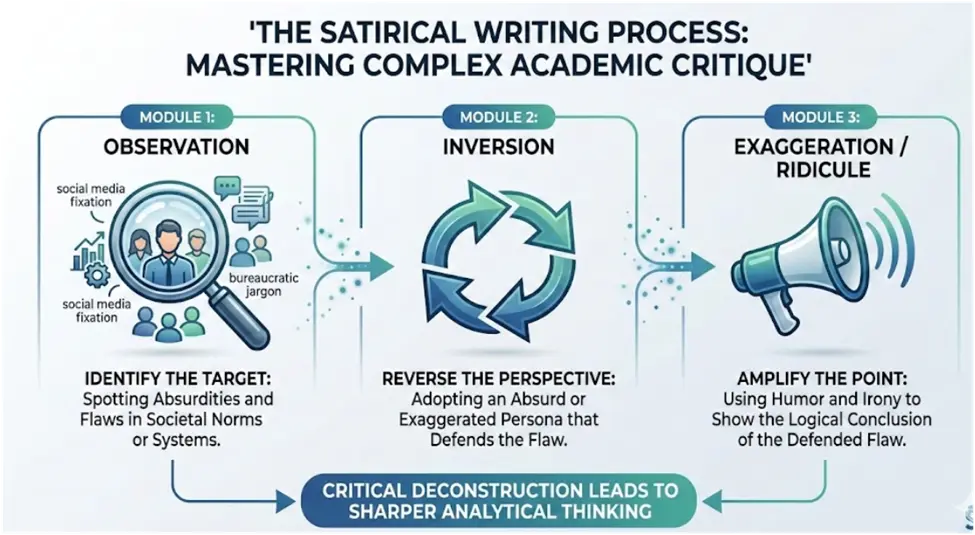
To write this effectively, a student must:
- Identify a genuine problem (The Target).
- Adopt a persona that defends the problem (The Mask).
- Use exaggeration to show why the defense is ridiculous (The Satire).
Why Critical Thinking is a Survival Skill
Critical thinking is the ability to analyze information objectively and make a reasoned judgment. In 2026, we are bombarded with “deepfakes” and biased algorithms. Satire trains the brain to look for the “subtext”—what is being said between the lines. If you can write satire, you can detect when you are being manipulated by others. This intellectual defense mechanism is perhaps the most valuable takeaway from a liberal arts education today.
Managing the Modern Workload: A Comparison
Students today are managing more than just essays. They are balancing internships, digital portfolios, and complex modular exams. Sometimes, the mental leap required to switch from a technical lab report to a creative satirical piece is too wide to cross alone.
| Assignment Type | Cognitive Demand | Primary Skill Developed |
| Research Paper | High (Data-driven) | Information Synthesis |
| Satirical Essay | Very High (Creative/Analytical) | Critical Deconstruction |
| Case Study | Medium (Applied) | Problem Solving |
| Lab Report | Medium (Observational) | Technical Accuracy |
When the pressure of these various demands converges, many students find that they need a professional sounding board to maintain their GPA. Seeking out essay writing help from a trusted service like MyAssignmentHelp allows a student to see how a professional structure is built. This isn’t about taking a shortcut; it’s about learning the “architecture” of a high-scoring paper so you can replicate it in your future work. Seeing a professional handle a complex thesis provides a roadmap for your own academic journey.
The Global Tone: Why Satire Crosses Borders
One of the reasons satire is so effective for international students is its universal nature. While cultural references might change, the human tendency toward irony is global. Whether you are a student in London critiquing urban planning or a student in New York writing about the obsession with productivity apps, the mechanics remain the same.
Writing for a global audience in 2026 means using a tone that is accessible yet sophisticated. You want to avoid hyper-regional slang and focus on logic. A well-placed satirical observation about the “joys of 5:00 AM Zoom calls” resonates just as well in Singapore as it does in Sydney. This global relatability is exactly what makes guest posts and student blogs go viral, driving that essential traffic and engagement.
Breaking Down the Absurd: A Step-by-Step Guide
- Observe: Look for something in your daily student life that feels “off” or overly complicated.
- Invert: Imagine a world where that complication is considered a “feature” rather than a “bug.”
- Refine: Use precise language. The best satire isn’t angry; it’s calm and “deadpan.”
Conclusion: Preparing for the Post-Grad World
The skills you sharpen while writing a satire essay—observation, irony, and critical deconstruction—are the same skills used by top-tier marketing strategists, lawyers, and CEOs. They are the people who can see a trend, identify its flaws, and pivot toward a better solution.
Frequently Asked Questions
1. Why is satire considered a critical thinking tool in 2026?
Ans: Satire requires students to deconstruct a subject, identify its flaws, and invent a logical but absurd counter-perspective. This process exercises the brain’s ability to analyze subtext and bias, skills that are highly valued by employers and universities in a digital-first academic environment.
2. How do I choose the best satire essay topics for university?
Ans: Focus on topics with a clear “target,” such as bureaucratic inefficiencies, social media habits, or environmental policies. The best topics are those you understand deeply, allowing you to use irony effectively without losing the scholarly focus required for high grades.
3. Can I get professional essay writing help for creative assignments?
Ans: Yes. Seeking expert guidance from services like MyAssignmentHelp helps you understand the structural requirements of complex genres. A professional consultant can provide a roadmap for tone, pacing, and thesis development, ensuring your creative work remains academically rigorous and well-formatted.
4. What is the biggest challenge when writing satirical essays?
Ans: The most common hurdle is maintaining a “deadpan” tone. Students often lean too far into anger or obvious joking. Successful satire remains calm and serious while defending an absurd position, which requires a high level of rhetorical control and vocabulary.
5. How does mastering diverse essay styles improve career readiness?
Ans: Employers in 2026 look for “cognitive flexibility.” By mastering various styles—from technical reports to satirical critiques—you demonstrate that you can adapt your communication to different audiences, a vital skill for marketing, law, and executive leadership roles.
About The Author : Sienna Kelly
As a Career Strategist and Educational Consultant with over a decade of experience in academic development, I specialize in helping students navigate the shifting standards of global higher education. My work at MyAssignmentHelp focuses on bridging the gap between traditional research methods and the creative, critical thinking skills required in the modern classroom.
Also Read
- Effortless Ways to Keep Your Swimming Pool Swim-Ready
- Imploded Meaning & Hiatus Meaning: The Complete User-Friendly Guide
- Kroner Meaning Explained 2026 — Full Guide to Currency and Usage
