
Cricket in India is more than just a sport it is an emotion, honestly. And when it comes to the Indian Premier League, IPL, one team that always stays in the spotlight is Royal Challengers Bengaluru, RCB. Whether it is because of Virat Kohli, passionate fans or those unforgettable matches, RCB always trends on social media, even when you are not looking for it.
One question that often goes viral among IPL fans is
“RCB Ka Baap Kaun Hai?”
If you are a cricket lover and curious about the answer, this blog will explain everything in detail. From IPL records, to rivalries and fan wars, and also the social media trends, this is the complete story behind this famous keyword.
What Does “RCB Ka Baap Kaun Hai” Mean?
The phrase “RCB Ka Baap Kaun Hai” is mostly used by cricket fans during IPL banter, trolling, you know the vibe. In Indian slang, “baap” basically points to someone who dominates, or performs better consistently.
In IPL discussions, fans use this line to compare RCB with stronger, or more successful teams.
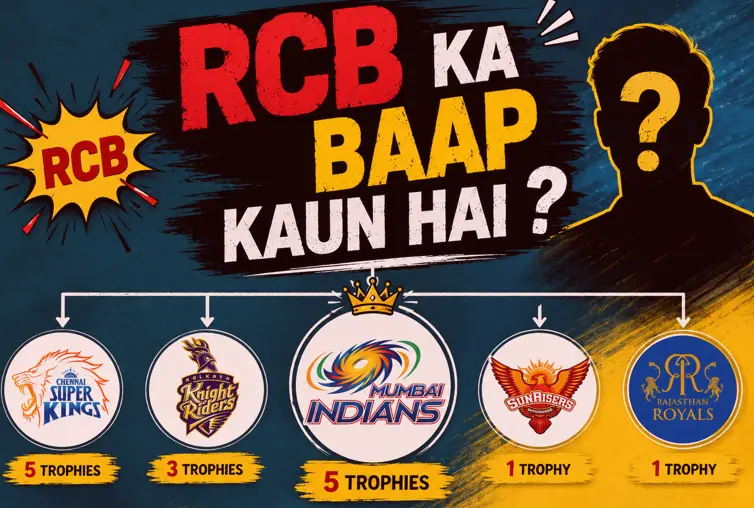
From IPL history, a lot of fans just keep saying Chennai Super Kings, CSK, is basically the answer to this question, because they have looked dominant over RCB in many seasons.
Why Is CSK Called RCB Ka Baap?
Fans call CSK “RCB ka baap” for a few real reasons, and yeah, it sticks.
1. Better Head-to-Head Record
In IPL matchups, CSK has mostly done better against RCB. Whenever these teams clash, CSK often seems to get that extra edge. It’s not that simple but this track record, gives fans the feeling that CSK is always on top, and RCB has to struggle.
2. More IPL Trophies
On the trophies side, the gap is pretty hard to ignore. RCB is still waiting for its first IPL title, while CSK has collected multiple cups, especially during MS Dhoni’s captaincy.
- IPL Titles Comparison
- Team IPL Titles
- Chennai Super Kings 5
- Mumbai Indians 5
- Royal Challengers Bengaluru 0
So when people go online, the trolling, memes, all that, gets stronger because of these numbers.
3. MS Dhoni’s Captaincy
MS Dhoni is widely treated as one of the greatest IPL captains. His steady mindset and sharp choices in pressure games, helped CSK beat RCB multiple times, when it mattered most.
Whenever Dhoni finishes a game against RCB, social media just , well, explodes with memes saying: “RCB Ka Baap Dhoni!”
RCB vs CSK: IPL’s Biggest Rivalry
The rivalry between RCB and CSK is one of the most exciting rivalries in IPL history, people talk about it nonstop.
Why Fans Love This Rivalry
- Virat Kohli vs MS Dhoni, it hits different every time.
- Aggressive versus calm leadership
- A massive fan base following
- High scoring matches, close moments
- Last over thrillers that keep everyone standing
Whenever RCB and CSK play, the whole cricket world watches closely , like it’s a ritual.
Virat Kohli: The Heart of RCB
Even though RCB has not won an IPL trophy yet, the team is still wildly popular, mainly because of Virat Kohli.
Kohli has been the face of RCB for many years, and honestly he is one of the biggest cricket stars across the world.
Virat Kohli’s IPL Achievements
- Highest run scorer in IPL history
- Most runs for a single franchise
- Record breaking 2016 IPL season
- Huge fan following across India
For many fans, RCB means Virat Kohli, first name in mind.
Why RCB Still Has the Most Loyal Fans
Despite not lifting the IPL trophy, RCB’s fan base is one of the strongest around cricket, like everyone talks about it anyway.
Reasons for RCB’s popularity
- Star players
RCB has always had legendary cricketers, such as
- Virat Kohli
- AB de Villiers
- Chris Gayle
- Faf du Plessis
2. Matches that entertain
RCB games are usually packed with massive sixes, tall totals, and really thrilling turning points
3. An emotional bond
Fans feel tied to the team, because RCB has lived through many ups and downs over the years, no joke.
- “Ee Sala Cup Namde” meaning
- A phrase that every IPL supporter seems to know is
- “Ee Sala Cup Namde”
- This Kannada line means
- “This year, the trophy is ours.”
RCB supporters use it every IPL season with hope and excitement. Even when rival fans troll it a lot, the slogan has become a big part of IPL culture now.
Godfather of Indian Cricket
The term “Godfather of Indian Cricket” is often used for those legendary personalities who did change the future of Indian cricket , mostly through leadership, performance and influence. From Sachin Tendulkar’s unmatched records to MS Dhoni’s iconic captaincy , and Virat Kohli’s aggressive passion, Indian cricket has seen a lot of legends that inspired millions of fans in the same breath. These cricket icons not only ruled the match, but also built India’s global image in world cricket . In this article we look at who truly deserves the title of the Godfather of Indian Cricket , and why fans across India keep debating this exciting topic .
Is Mumbai Indians also RCB ka Baap?
Some people think Mumbai Indians, MI, can also be called RCB’s “baap”, because MI is among the most successful IPL teams.
Why MI fans say this
- MI has won 5 IPL trophies
- Rohit Sharma’s captaincy keeps showing up in the conversation
- Strong playoff performances, sure, but also the way they stay steady
- Better overall IPL record
Still, in fan discussions and memes, CSK gets brought up way more often as RCB’s main enemy, even if that feels a bit stubborn
Why Has RCB Never Won the IPL Trophy?
This is one of the biggest questions in IPL history, maybe the biggest
Even with superstar players in the squad, RCB has not managed to lift the IPL title
Here are the main reasons, in plain terms
1. Weak Bowling Attack
RCB usually built strong batting lineups, but their bowling unit struggled in multiple seasons
Where teams like CSK and MI went for balance, RCB often relied heavily on batting stars only
2. Pressure in Knockout Matches
RCB made it to IPL finals more than a few times, but when it mattered, they couldn’t handle the pressure
RCB IPL Final Appearances
- 2009
- 2011
- 2016
And yep, they lost all three finals, no excuses there
3. Frequent Team Changes
RCB changed players and tactics too frequently, so the team rhythm got broken again and again
Best Players in RCB History
RCB ne kuch unforgettable IPL legends produce kiye hai, jo fans ne aaj tak yaad rakhe hain. Thoda sa memory lane sa feel aata hai, sach me.
1. Virat Kohli
RCB ki core strength bol sakte hain, aur IPL ke all-time leading run scorer bhi.
2. AB de Villiers
Inko “Mr. 360” kehte hai, ABD ne aise-aise shots khele jo logically possible lagte hi nahi. Aur phir bhi RCB ke liye countless games jita diye.
3. Chris Gayle
Chris Gayle ki explosive batting ki wajah se RCB, IPL ke sabse entertaining teams me ginni jaati thi.
Inka legendary 175* abhi bhi sabse top highest individual IPL score ke naam se famous hai.
So can RCB win the IPL in the future? Yes, absolutely yes.
RCB has improved in recent seasons, like the overall squad looks much more balanced now, not just in theory but also on the field. Still, what RCB really needs to win the IPL comes down to a few clear things, strong bowling lineup, better performance when the pressure gets heavy, smart captaincy, and consistency during the playoffs. If those pieces click together, RCB can finally lift the IPL trophy.
Also, RCB fans never give up. That’s the part that makes the team different, they have this loyal fan base that keeps backing the side even after years without a trophy. The Chinnaswamy Stadium in Bengaluru, it always lights up the match day atmosphere, it feels electrifying from ball one. That kind of loyalty shows cricket is not just about trophies, it is about emotions and passion too.
Dhoni vs Kohli, and the main reason behind the rivalry
The biggest reason behind “RCB Ka Baap Kaun Hai” becoming so popular, is that fan rivalry between MS Dhoni supporters and Virat Kohli supporters. People talk about it again, and again maybe every season, you know.
- MS Dhoni Fans Say
- Dhoni has more trophies
- Better captaincy record
- More success in pressure situations
- Virat Kohli Fans Say
- Kohli is the greatest modern batter
- Most loyal IPL player
- Massive global fan base
So this back and forth, keeps IPL social media alive. Every year, someone is posting stats, clips, and opinions, like it is a daily ritual.
Final Answer: “RCB Ka Baap Kaun Hai?”
If we look at IPL trophies, head-to-head records, and what fans insist on, many people end up saying:
“Chennai Super Kings (CSK)”
But cricket can be unpredictable, so no side stays on top forever.
RCB still remains one of the most loved and entertaining teams in IPL history, and with passionate fans, plus superstar players, the squad still has a real chance to lift more future IPL trophies.
Conclusion
The keyword “RCB Ka Baap Kaun Hai” isn’t just a question, it is part of IPL entertainment and fan wars in India cricket culture.
While CSK is usually mentioned as RCB ka sabse bada rival because of its success and dominance, RCB still keeps that unmatched popularity because of Virat Kohli and its very loyal supporters, you know how it goes.
Even if trolling happens online , one thing stays true , IPL would never be this exciting without RCB.
FAQs
1. Who is called RCB ka baap in IPL?
Many fans call Chennai Super Kings (CSK) as RCB ka baap, mainly due to a stronger IPL record and trophies.
2. Has RCB ever won the IPL trophy?
No, RCB has never won an IPL title, not till now.
3. Why is RCB so popular?
RCB stays in the spotlight because of Virat Kohli, loyal fans, and matches that feel entertaining again and again.
4. What does “Ee Sala Cup Namde” mean?
It means “This year, the cup is ours”.
5. Who are the biggest legends of RCB?
Virat Kohli, AB de Villiers, and Chris Gayle are seen as RCB legends.
Also Read
- Apartment or Private Home, Which Is Better for Your Health?
- Building a Buffer to Protect Your Finances
- 201+ Lifeguard Puns and Jokes One Liner in 2025
